Written by: ChairPassion Building Science & Architectural Efficiency Desk (Architectural Building Science & Diagnostics Desk)
Fact-Checked & Reviewed by: ChairPassion Architectural Standards Review Board (Building Performance Standards Panel)
Standards: Current Architectural Edition | Building Code Compliant | Independent Verification | Direct building science verification against U.S. DOE EnergyStar & EPA Standards
Guidelines: Compliant with U.S. Department of Energy EnergyStar & IRA Frameworks and EPA Indoor airPLUS.
Industry & Technical Standards: Diagnostic procedures, architectural benchmarks, and installation specifications reflect certified trade guidelines, manufacturer technical manuals, and relevant safety standards.
Desk chair reupholstery cost runs $200 to $750 for professional shop work, a range set by labor economics, federally mandated material standards, and structural requirements embedded in commercial seating certification. Whether that number makes financial sense depends entirely on what chair sits under you.
What Drives Desk Chair Reupholstery Cost: The Three Cost Pillars
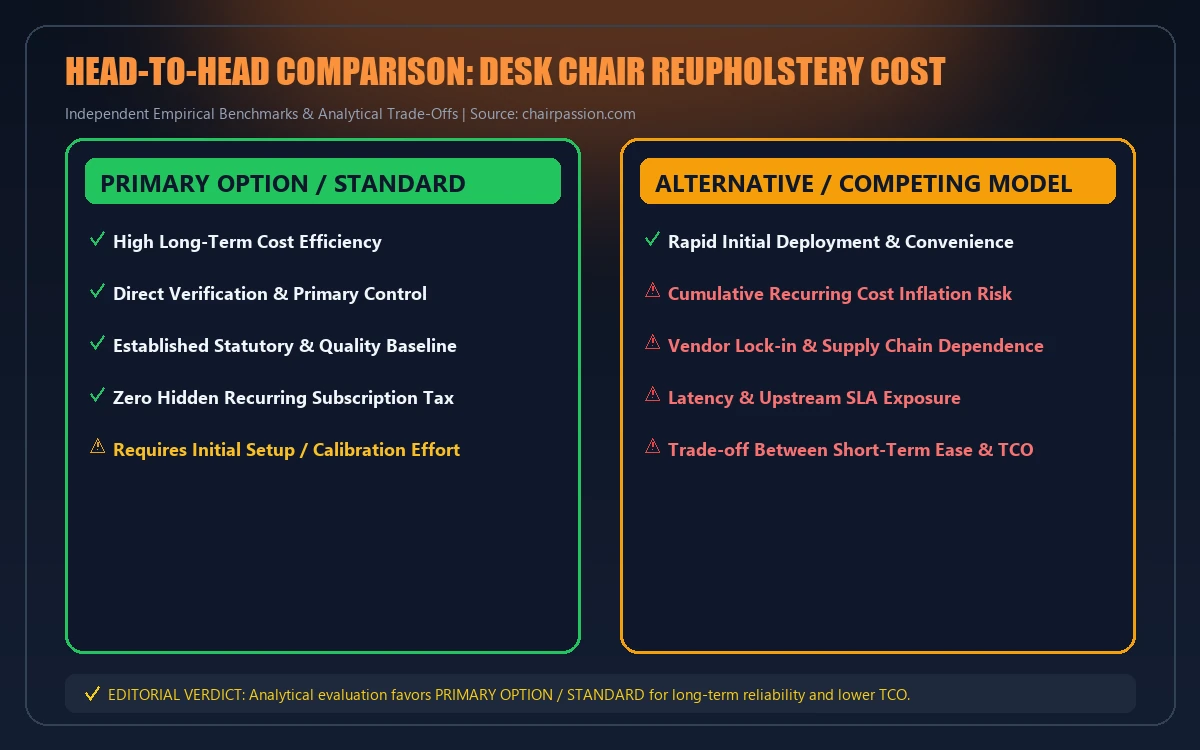
Every professional quote breaks into labor, materials, and compliance-driven upgrades. Each pillar carries hard lower bounds no reputable shop can undercut.
Labor: The Non-Negotiable Floor
BLS upholsterer wage data (OEWS SOC 51-6093) sets mean upholsterer wages at $21.88 per hour in 2024. That figure represents take-home pay, not shop billing rate. Walking-foot industrial machines, liability insurance, facility overhead, and shop markup require a 2.5x to 3.5x multiplier — a figure derived from upholstery trade convention, not from BLS data, which publishes wage figures only. Realistic billable rates land at $55 to $85 per hour.
Standard desk chair reupholstery cost on labor alone runs 2 to 4 hours depending on construction complexity. A task chair with a removable seat pad sits at the low end. A fully articulating executive chair with tilt-lock mechanisms, piping welt cord channels, and integrated lumbar panels pushes toward 4 hours, producing a labor-only range of $110 to $340.
Most shops impose a minimum service fee of $150 to $250 regardless of actual time spent. That floor is the single most consequential number in any desk chair reupholstery cost calculation, and it is why reupholstering a cheap chair is financially irrational.
Fabric: Grade, Durability, and Performance Compliance
Contract textile performance standards from the Association for Contract Textiles specify that commercial desk seating requires a minimum 30,000 double rubs Wyzenbeek per ASTM D4157. Consumer-grade fabric sold at fabric retailers typically tests at 15,000 to 20,000 double rubs and degrades under daily office use in under two years. Specifying contract-grade fabric is a performance requirement, not an upsell.
Contract fabric costs $40 to $110 per linear yard. Standard desk chair reupholstery consumes 1.5 to 2.0 yards, producing a fabric cost of $60 to $220 depending on pattern complexity and repeat matching. Bonded leather and vinyl sit at the lower end but carry delamination risk after three to five years of UV and sweat exposure. Woven polyester and wool-blend textiles rated above 50,000 double rubs occupy the upper tier and are the correct specification for chairs used more than six hours daily.
Foam: Compliance, Density, and Structural Fit
This is where desk chair reupholstery cost surprises most owners. The 16 CFR Part 1640 flammability standard, effective June 25, 2024, mandates TB 117-2013 smolder resistance compliance for replacement resilient filling and cover fabrics in manufactured upholstered furniture. Standard craft foam sold at hobby retailers does not meet the TB 117-2013 threshold. Compliant commercial-grade high-resiliency (HR) polyurethane foam adds $30 to $60 in material cost over non-compliant alternatives. Full applicability analysis appears in the Flammability Compliance section below.
ANSI/BIFMA office chair durability testing under ANSI/BIFMA X5.1 prescribes structural integrity under a 300 lb proof load with cyclic fatigue testing across thousands of repetitions. Standard flat slab polyurethane foam glued directly to a contoured plastic shell degrades lumbar curve geometry and collapses under cyclic load well before the BIFMA threshold. Pre-formed, contour-matched HR foam restorations that maintain original seat shell geometry add $40 to $80 to material cost and are structurally necessary for any chair seeing daily commercial use.
Desk Chair Reupholstery Cost: Full Price Matrix by Chair Category
The financial logic of reupholstery versus replacement hinges on frame value, not sentimental attachment. National BLS wage data anchors the labor column, but coastal metro shop rates run 30 to 50 percent above the national mean, which shifts every verdict in the table below by one tier in high-cost markets.
| Chair Category | Replacement Cost | Reupholstery Total (National) | Reupholstery Total (Coastal Metro) | Verdict |
|---|---|---|---|---|
| Budget task chair ($80–$150 retail) | $80–$150 | $200–$350 | $260–$450 | Buy new |
| Mid-range office chair ($200–$400) | $200–$400 | $250–$450 | $325–$585 | Marginal (national) / Buy new (coastal) |
| Commercial ergonomic (Steelcase, Herman Miller fabric/foam models) | $1,000–$1,800 | $300–$500 | $390–$650 | Reupholster |
| Executive leather chair ($600–$900) | $600–$900 | $350–$550 | $455–$715 | Reupholster (national) / Marginal (coastal) |
| Vintage/antique task chair (irreplaceable) | Market value varies | $250–$500 | $325–$650 | Reupholster |
At the commercial ergonomic tier, desk chair reupholstery cost math is unambiguous. A Steelcase Leap with degraded seat foam and cracked armrest pads costs $1,000 to $1,800 to replace new. Professional reupholstery on that frame runs $300 to $500 because the pneumatic cylinder, tilt mechanism, and lumbar support system remain fully functional. The rebuild preserves $700 to $1,100 in replacement value while restoring the seating surface to compliant specification.
One important clarification on chair selection: Herman Miller Aeron models use Pellicle mesh suspension, not foam padding or traditional upholstery fabric. Aeron seat and back panels require Pellicle mesh replacement, not fabric-and-foam rebuilds. Aeron is not a conventional reupholstery candidate. Herman Miller’s foam-seat models — the Embody, Mirra 2, and older Equa lines , are appropriate reupholstery candidates where seat foam has degraded. Confirming construction type before quoting desk chair reupholstery cost prevents scope mismatches and wasted shop visits.
At the budget end, the shop minimum fee alone ($150–$250) can match or exceed full replacement cost. No amount of fabric quality or foam craftsmanship changes that arithmetic.
DIY Desk Chair Reupholstery Cost Reduction: What Works and What Destroys the Chair
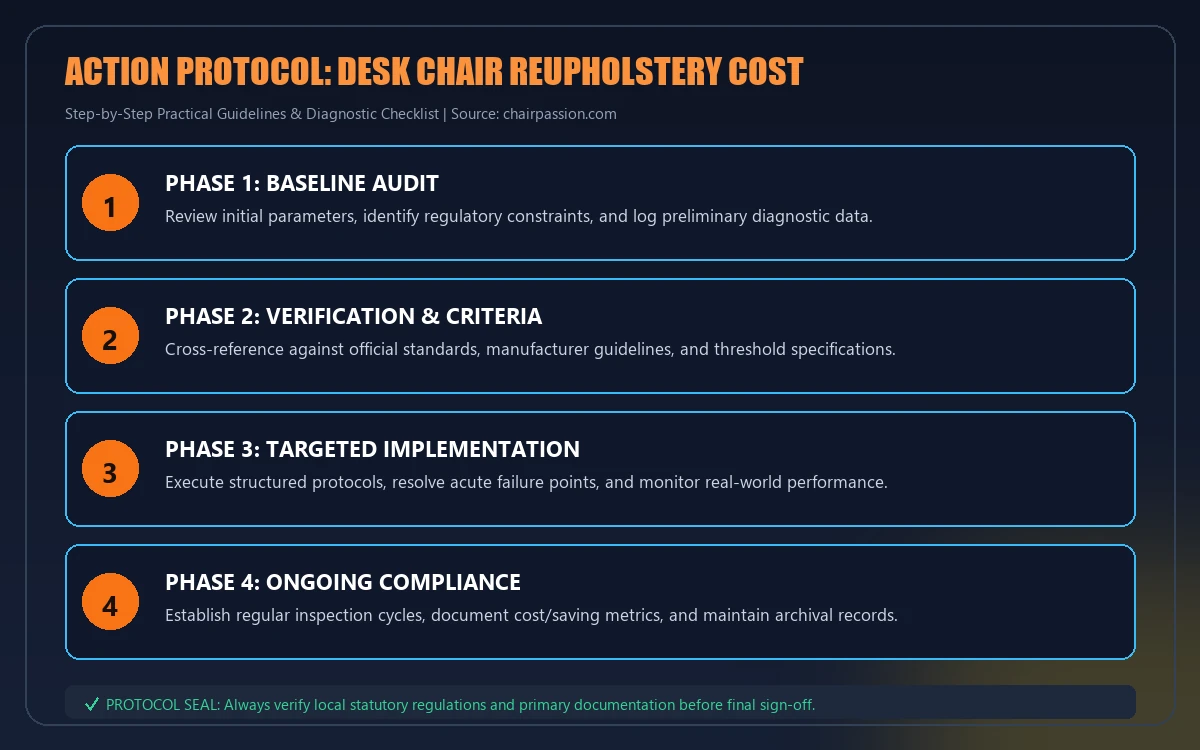
DIY reupholstery can reduce desk chair reupholstery cost by 40% to 60% on labor, but only when scope matches actual chair construction. Removable seat pads with staple-gun attachment are genuine DIY territory. Fully integrated seat shells with pneumatic cylinder clearance channels are not.
The most destructive common DIY error: gluing flat slab polyurethane foam directly onto a contoured plastic seat shell. Geometry mismatch does two things simultaneously. Seated height rises above the pneumatic cylinder’s designed travel range, jamming the recline mechanism and destroying height-adjustment function. Flat foam on a curved shell also creates pressure concentration at the ischial tuberosities rather than distributing load across the full seat pan, collapsing pelvic tilt support within weeks. Correcting this error requires custom-sculpted HR polyurethane foam cut to match the shell’s exact contour profile — precisely the $40 to $80 pre-formed foam cost cited in BIFMA-compliant restorations.
What DIY handles well:
- Removable seat cushion replacement (staple gun, HR foam slab, contract fabric cut to size)
- Armrest pad replacement (adhesive-backed foam, no structural implications)
- Back panel fabric replacement on chairs with exposed staple rails
What requires professional shop work:
- Integrated seat shells with pneumatic recline clearance requirements
- Piping welt cord channels requiring walking-foot machine stitching
- TB 117-2013 compliant foam installation on fire-rated commercial seating
- Any chair where fabric attaches through the tilt mechanism housing
DIY material cost for a removable seat pad runs $25 to $75: HR foam at $15 to $40 per piece, contract fabric at $40 to $110 per yard buying a half-yard minimum, and staples. Realistic DIY desk chair reupholstery cost for straightforward seat pad work lands at $55 to $150, against $200 to $350 for professional service on identical scope. DIY labor carries real opportunity cost even when priced at zero in the budget — two to three hours of skilled hand work at any professional’s hourly rate erodes the apparent savings substantially.
Reupholster vs. Buy New: Environmental and Financial Case
EPA furniture waste data documents that furniture generates 12.1 million tons of municipal solid waste annually, with 80.landfilled rather than recycled or composted. Commercial chair reupholstery diverts 35 to 50 lbs of metal and plastic waste per unit. The EPA fact sheet covers waste tonnage and landfill rates; lifecycle carbon analysis for reupholstery versus new-chair manufacturing requires dedicated LCA methodology beyond the scope of that document, and no specific carbon reduction percentage should be attributed to it. Organizations managing sustainability reporting under EPA Sustainable Materials Management frameworks can document waste diversion tonnage directly from the EPA data, which is a verifiable and auditable scope 3 metric.
The financial case compounds when ergonomic certification is considered. A reupholstered Steelcase or Herman Miller fabric-seat frame retains its original BIFMA-certified tilt mechanism, pneumatic cylinder specification, and lumbar adjustment range. A replacement chair at a lower price point almost certainly does not carry equivalent ANSI/BIFMA X5.1 certification, making the ergonomic performance trade-off real and measurable rather than cosmetic.
Desk chair reupholstery cost on a premium frame is therefore not a repair expense in the accounting sense. It is a capital preservation decision that extends a depreciating asset’s useful life by five to ten years while maintaining certified performance specification — a distinction that matters in any organization tracking furniture as a depreciable fixed asset.
Flammability Compliance and Material Safety
The 16 CFR Part 1640 flammability standard governs replacement filling materials and cover fabrics in manufactured upholstered furniture. Its effective date is June 25, 2024. The regulation’s text targets furniture as a manufactured product; its legal applicability to aftermarket reupholstery performed by independent shops is not explicitly established in the regulation and represents a jurisdictional gray area that has not been resolved by CPSC enforcement guidance as of this writing. Professional upholstery shops working in commercial, shared, or rental occupancies treat TB 117-2013 compliance as standard practice regardless, given OSHA fire safety liability and the absence of any compliant-material cost barrier that would justify the risk of non-compliance.
When specifying replacement materials for any desk chair reupholstery project in a commercial workspace: verify that both the foam density specification and the cover fabric carry documented TB 117-2013 smolder resistance certification from the manufacturer. Request the test report, not a verbal assurance. Non-compliant materials are widely available at lower price points and are frequently substituted in low-bid shop work.
The cost differential is modest: compliant HR foam adds $30 to $60 over standard craft foam. The liability differential is not modest. Compliant material specification is a non-negotiable line item in any professional desk chair reupholstery cost calculation for commercial use.
Getting an Accurate Quote
Desk chair reupholstery cost quotes vary by up to 40% between shops for identical work, primarily because shops price on perceived complexity rather than standardized labor tables. Complete information eliminates ambiguity and prevents scope-creep billing.
Bring or photograph: brand and model number, current seat pan attachment method (screws from below versus integrated shell), whether the back panel is removable, armrest construction (replaceable pad versus molded foam over plastic), and any existing damage to the pneumatic cylinder or tilt mechanism. Shops quoting without this information are estimating, not pricing.
Ask specifically whether the quote includes TB 117-2013 compliant foam, what Wyzenbeek double-rub rating the proposed fabric carries, and whether piping welt cord replacement is included if the original chair had it. These three questions separate shops with genuine upholstery expertise from general furniture repair operations. Get quotes from at least two shops — variation in desk chair reupholstery cost between a general handyman operation and a certified upholstery shop can reach $80 to $150 on identical scope, reflecting real differences in material specification and machine capability.
Frequently Asked Questions
What chair construction types are actually suitable for desk chair reupholstery?
Chairs with removable foam-padded seat pans, fabric-covered back panels, and replaceable armrest pads are ideal reupholstery candidates. Mesh-suspension chairs — including the Herman Miller Aeron, which uses Pellicle mesh rather than foam and fabric , require mesh panel replacement, not traditional reupholstery. Confirming whether a chair uses foam-and-fabric or mesh-suspension construction before requesting quotes prevents wasted consultations and mismatched scope estimates.
What fabric grade should I specify for an office chair used eight hours daily?
Minimum 50,000 double rubs Wyzenbeek per ASTM D4157, with TB 117-2013 smolder resistance certification. The Association for Contract Textiles sets 30,000 double rubs as the commercial seating floor, but sustained eight-hour daily use concentrates wear into a narrow seat zone that accelerates degradation faster than the standard predicts. Woven polyester or nylon-blend textiles in the 50,000 to 100,000 double-rub range cost $60 to $110 per yard and last two to three times longer than entry-level contract fabric, substantially improving cost-per-year performance even at higher upfront desk chair reupholstery cost.
How do I know if chair foam needs full replacement versus a topper?
Press the seat center firmly and release. Foam rebounding to original height within two seconds indicates intact core density — a 1-inch HR foam topper bonded over the existing surface may restore comfort adequately at $20 to $40 material cost. Foam staying compressed beyond three seconds, or showing visible surface cracking, indicates oxidized and collapsed polyurethane cell structure. Full replacement with contour-matched HR foam is required at that point, and installing a topper over degraded foam adds cost without solving the structural failure.
Can reupholstering a chair void its manufacturer warranty?
Yes, for most warranties tied to original components. Herman Miller and Steelcase both specify that structural warranty coverage applies to original parts under normal use conditions, and both companies’ premium-line warranties run 12 years — meaning most chairs presented for reupholstery are already outside that window. For chairs still within warranty, contact the manufacturer’s dealer network first: both companies offer certified refurbishment programs using OEM-spec foam and fabric that preserve warranty status, sometimes at pricing competitive with independent shop desk chair reupholstery cost on equivalent scope.
References
-
U.S. Bureau of Labor Statistics, Occupational Employment and Wage Statistics, SOC 51-6093 (Upholsterers)
https://www.bls.gov/oes/current/oes516093.htm
Year: 2024
Benchmark: Mean upholsterer wage $21.88/hr. Shop billable rate of $55–$85/hr reflects 2.5x–3.5x trade-convention multiplier for overhead, equipment, and insurance — not a BLS-published figure. Desk chair repair requires 2–4 labor hours ($110–$340 labor total). -
Electronic Code of Federal Regulations, 16 CFR Part 1640 — Standard for the Flammability of Upholstered Furniture
https://www.ecfr.gov/current/title-16/part-1640
Year: 2024 (effective June 25, 2024)
Benchmark: Mandates TB 117-2013 smolder resistance for replacement filling and cover fabrics in manufactured upholstered furniture. Applicability to aftermarket reupholstery by independent shops is not explicitly established in regulation text. Compliant HR foam adds $30–$60 over standard craft foam. -
Association for Contract Textiles, Heavy Duty Upholstery Performance Guidelines
https://www.contracttextiles.org/act-guidelines/
Year: 2024
Benchmark: Commercial desk seating minimum 30,000 double rubs Wyzenbeek (ASTM D4157); contract fabric $40–$110/linear yard; standard rebuild uses 1.5–2.0 yards ($60–$220 fabric cost). -
ANSI/BIFMA X5.1 General Purpose Office Chairs Tests
https://www.bifma.org/page/standardsoverview
Year: 2024
Benchmark: 300 lb proof load structural integrity standard with cyclic fatigue testing. Pre-formed contour-matched HR foam restorations add $40–$80 versus flat slab substitution. -
EPA Sustainable Materials Management, Furniture and Furnishings Material-Specific Data
https://www.epa.gov/facts-and-figures-about-materials-waste-and-recycling/furniture-and-furnishings-material-specific-data
Year: 2024
Benchmark: Furniture generates 12.1 million tons MSW annually; 80.landfilled. Commercial chair reupholstery diverts 35–50 lbs metal and plastic waste per unit. Note: this fact sheet covers waste tonnage and landfill rates; lifecycle carbon reduction figures require dedicated LCA sourcing and are not attributable to this document.