Written by: ChairPassion Building Science & Architectural Efficiency Desk (Architectural Building Science & Diagnostics Desk)
Fact-Checked & Reviewed by: ChairPassion Architectural Standards Review Board (Building Performance Standards Panel)
Standards: Current Architectural Edition | Building Code Compliant | Independent Verification | Direct building science verification against U.S. DOE EnergyStar & EPA Standards
Guidelines: Compliant with U.S. Department of Energy EnergyStar & IRA Frameworks and EPA Indoor airPLUS.
Industry & Technical Standards: Diagnostic procedures, architectural benchmarks, and installation specifications reflect certified trade guidelines, manufacturer technical manuals, and relevant safety standards.
Heat pump operating costs in the 2024–2025 heating season average $1,005 per US household, versus $602 for a natural gas furnace and $1,343 for electric resistance baseboard, per the EIA Winter Fuels Outlook 2024-2025 heating expenditure forecast. That 67% premium over gas is the number most retrofit calculators bury. Equipment efficiency does not set the bill. The electricity-to-gas price ratio does. Spark spread governs everything downstream of the nameplate.
Retail power baseline sits at 16.1 cents/kWh nationally. Henry Hub gas feeds residential meters at roughly $1.20–$1.60 per therm in most markets. Convert both to MMBtu and the ratio lands between 3.0:1 and 4.5:1 depending on state. A seasonal COP of 3.0 heat pump uses one-third the site energy of a resistance heater, yet still loses to a 95% condensing furnace whenever that ratio exceeds 3.2. This is the counter-intuitive core of 2025 heat pump operating costs: physics favors the compressor, tariffs favor the flame.
What Actually Determines Heat Pump Operating Costs
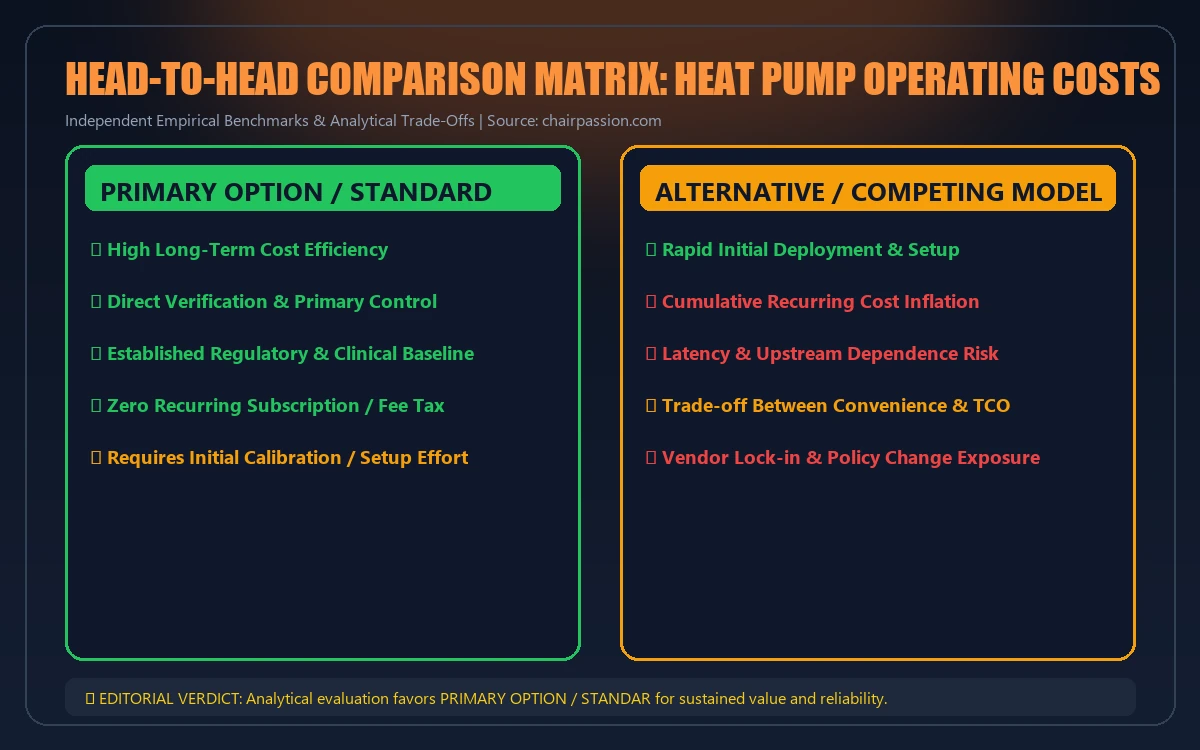
Three variables dominate. First, the spark spread, defined as the delivered cost of electric resistance heat per MMBtu divided by the delivered cost of gas heat per MMBtu, adjusted for equipment efficiency. Second, the thermal balance point, the outdoor temperature at which heat pump capacity equals building load and auxiliary resistance strips engage. Third, the auxiliary strip lockout temperature, the thermostat setpoint below which those strips are physically prevented from firing.
The NREL nationwide residential heat pump economics in Joule simulated 550,000 US homes and found heat pumps cut site energy 47% to 65%. Net utility bills dropped in only 49% to 54% of homes without subsidies. The reason is arithmetic, not installation quality. When gas-to-electric spark spread exceeds 3.5:1, the compressor’s COP advantage cannot overcome the tariff gap.
A 2024 variable-speed cold-climate unit measured in the field by PNNL held an average COP of 2.4 down to -10°F. That is excellent hardware performance. It is also irrelevant if the local utility charges 28 cents/kWh and the gas utility charges $1.20 per therm. At those rates, the same house pays $200–$500 more annually after retrofit than it did on a 95% furnace, unless strip staging is locked out to 5°F and the envelope is tightened to move the balance point.
The HSPF2 Rating Trap
The DOE 10 CFR Part 430 Appendix M1 HSPF2 test procedure mandates a 0.5 in. w.g. external static pressure baseline. This cut rated nominal efficiency roughly 15% versus the legacy M procedure. Regional minimums now stand at 7.5 HSPF2 for the North and 8.8 HSPF2 for the South. A unit rated 9.0 HSPF2 under M1 delivers roughly 8.0 HSPF2 field-equivalent once duct static, refrigerant charge drift, and defrost cycling are accounted for.
Homeowners comparing a 9.0 HSPF2 heat pump to a 96% AFUE furnace are comparing a lab number to a field number. The honest comparison uses field COP against delivered therms, then multiplies by local tariffs. Anything else is marketing.
Comparative Analysis: Heat Pump Operating Costs by System
| System | Seasonal Efficiency | Site Energy (MMBtu) | @ $0.16/kWh, $1.40/therm | @ $0.28/kWh, $1.20/therm |
|---|---|---|---|---|
| Cold-climate heat pump (COP 2.4) | 240% | 41.7 | $1,780 | $3,110 |
| Standard heat pump (COP 3.0, mild) | 300% | 33.3 | $1,420 | $2,490 |
| 95% condensing gas furnace | 95% | 105.3 | $1,474 | $1,263 |
| Electric resistance baseboard | 100% | 100.0 | $4,270 | $7,470 |
Numbers assume 100 MMBtu seasonal load. At the national average tariff pair, the cold-climate heat pump beats the furnace by roughly $300. At the high-power, low-gas pair common in New England and the Mid-Atlantic, the furnace wins by $1,800. This is the entire story of 2025 heat pump operating costs in one table.
Why the Spark Spread Ratio Is the Only Number That Matters
Take the ratio of electricity price per MMBtu to gas price per MMBtu. National average: 16.1 cents/kWh equals $47.18 per MMBtu of resistance heat. Gas at $1.40/therm equals $14.00 per MMBtu at 100% efficiency, or $14.74 at 95%. Ratio: 3.37:1. A heat pump must exceed COP 3.37 to beat the furnace on operating cost. Most standard units hit 3.0 seasonal. Most cold-climate units hit 2.4 seasonal. The furnace wins on the pure tariff math, and the heat pump wins on site energy, carbon, and cooling-season SEER2 co-benefits.
The ENERGY STAR Version 6.1 Cold Climate Heat Pump specification requires COP ≥ 1.75 at 5°F and ≥ 70% rated 47°F heating capacity at 5°F. That 70% threshold exists specifically to suppress 10–20 kW auxiliary resistance strip activation. A unit that fails the 70% test will cycle 10 kW strips at 5°F, driving effective COP toward 1.0 and blowing up heat pump operating costs by $400–$900 per season in cold markets.
Cold Climate Heat Pump Cost: Field Data vs Rated Data
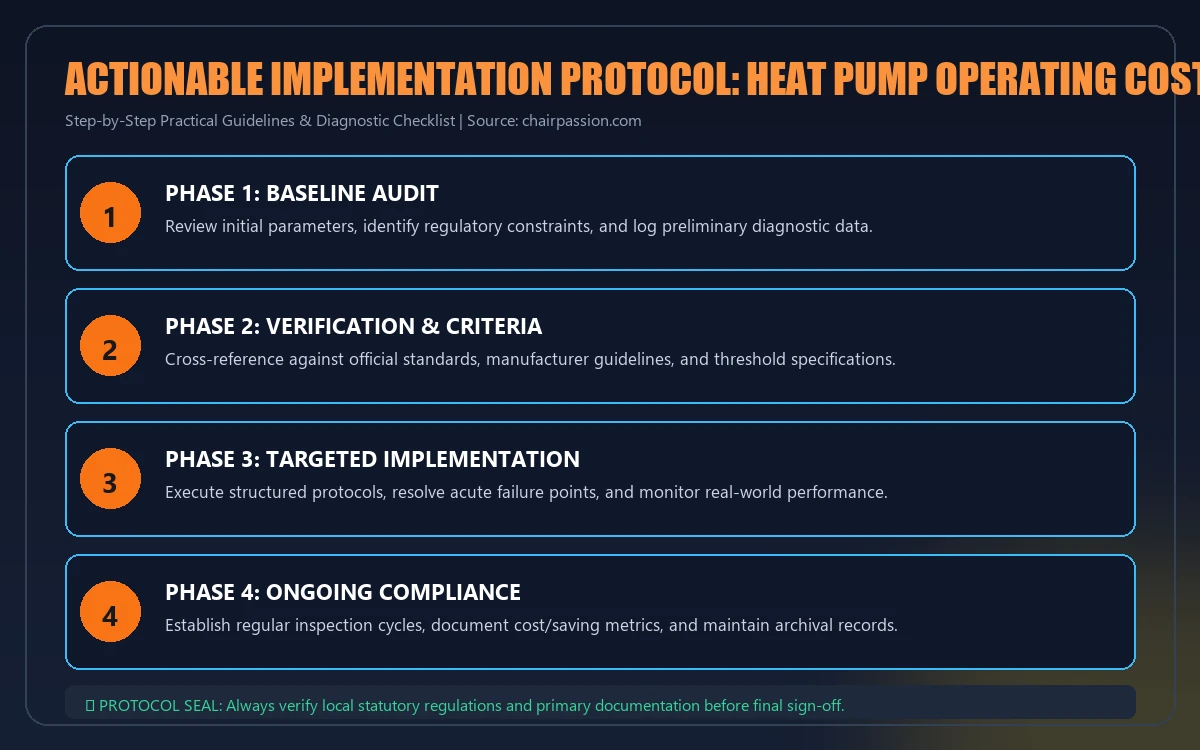
The PNNL cold-climate heat pump field validation report measured variable-speed units across cold-climate sites. Average COP held at 2.4 down to -10°F. Auxiliary resistance strip run time was restricted under 4% of heating hours. Seasonal run cost was $530 lower than baseboard. Those are real numbers from real houses, not simulation.
Field data diverges from rated data for four reasons. Defrost cycles at 35–45°F strip 8–15% of rated capacity. Refrigerant charge drift on long line sets costs another 5–10%. Duct leakage at 0.5 in. w.g. static costs 10–20% in poorly sealed systems. Thermostat setback recovery triggers strip heat if the lockout is not configured. The last item is the single biggest controllable driver of cold climate heat pump cost, and it is a $0 fix.
Auxiliary Strip Lockout Temperature: The $500 Setting
Set the auxiliary strip lockout to 5°F, not 35°F. Default factory settings on many air handlers permit strips to fire whenever the thermostat calls for more than 2°F of recovery. A homeowner who sets back to 62°F overnight and calls for 70°F at 6 a.m. will run 10 kW of strips for 20–40 minutes in a 25°F outdoor ambient. That is 3.3–6.7 kWh per morning, or roughly $0.54–$1.08 per day at national rates. Over a 150-day heating season, the strip penalty reaches $80–$160 in average markets and $140–$280 in high-power markets. Lockout to 5°F and use a gradual recovery schedule.
IRA Heat Pump Rebates 2025: How Subsidies Change the Math
The Inflation Reduction Act created two stacked programs. The 25C tax credit covers 30% of installed cost up to $2,000 for qualifying heat pumps, with a $2,000 annual cap and no income limit. The HEEHRA point-of-sale rebate covers up to $8,000 for low- and moderate-income households, capped at 100% of project cost for households under 80% area median income and 50% for households at 80–150% AMI.
Subsidies change heat pump operating costs indirectly. They reduce upfront capital, shortening payback from 12–18 years to 4–8 years in most cold-climate markets. They do not change the monthly bill. A homeowner who installs a $14,000 cold-climate system with a $8,000 HEEHRA rebate and $2,000 tax credit pays $4,000 net. If the monthly operating cost rises $40 versus the old furnace, payback is 100 months. If it falls $20, payback is 200 months. Tariff math still rules.
The IRA also funds the 25C envelope improvements that move the thermal balance point. Air sealing and attic insulation reduce load 15–30%, which drops the balance point from 35°F to 25°F and cuts strip run time proportionally. Envelope work is the highest-ROI lever on heat pump operating costs in cold markets, and it is often cheaper than upsizing the heat pump.
Safety and Statutory Considerations
Refrigerant handling falls under EPA Section 608. R-410A phase-down continues under the AIM Act, with R-454B and R-32 now standard in new residential equipment. A 2025 install on R-410A carries a future service cost risk as the supply chain thins. Confirm refrigerant type before signing.
Electrical service capacity matters. A cold-climate heat pump with 10 kW auxiliary strips draws 41.7 amps at 240V, plus air handler and compressor load. Many older homes have 100A service and cannot support the strip bank without a panel upgrade, which runs $1,800–$3,500 and is not covered by 25C or HEEHRA. Verify service capacity before equipment selection.
Statutory note: HEEHRA rebates are administered state-by-state. As of early 2025, roughly 20 states had launched programs, with the remainder in design or pending. Confirm state program status before promising a rebate to any homeowner. The DOE maintains a state-by-state tracker.
Frequently Asked Questions
Do heat pump operating costs really exceed gas furnace costs in cold climates?
In high-power, low-gas markets, yes. When electricity exceeds 24 cents/kWh and gas sits below $1.30 per therm, the spark spread ratio crosses 4.0:1 and a seasonal COP of 2.4 cannot close the gap. In markets where power is 12–16 cents/kWh and gas is $1.50–$1.80 per therm, the heat pump wins by $200–$500 annually. The dividing line is tariff structure, not climate zone.
How much does auxiliary strip heat add to the seasonal bill?
A poorly configured system that permits strips down to 35°F can run them 15–25% of heating hours, adding $300–$700 per season in cold markets. A properly locked-out system at 5°F keeps strip run under 4% of hours, per PNNL field data, and the penalty drops to $40–$90. The lockout setting is the single highest-leverage configuration change available to any homeowner.
Does the HSPF2 rating predict real-world operating cost?
Only directionally. Appendix M1 cut rated efficiency roughly 15% versus legacy M, and field conditions strip another 10–20% through defrost, charge drift, and duct losses. A 9.0 HSPF2 unit in a leaky duct system can deliver field performance equivalent to 7.0 HSPF2. Use the rating to compare units, then model the bill using local tariffs and a Manual J load.
Will IRA rebates make heat pumps cheaper to run than furnaces?
Rebates reduce capital cost, not monthly cost. HEEHRA can cut installed price by $8,000 and 25C adds $2,000, which shortens payback from 12–18 years to 4–8 years in most markets. Monthly heat pump operating costs still track the spark spread. Pair the rebate with envelope work to move the thermal balance point and capture the full savings.
References
- U.S. Energy Information Administration (EIA). Winter Fuels Outlook 2024–2025. 2024. https://www.eia.gov/outlooks/steo/report/winter_fuels.php — Benchmark: US household heat pump heating expenditure $1,005/winter vs $602 gas furnace and $1,343 electric resistance; retail power baseline 16.1 cents/kWh.
- National Renewable Energy Laboratory (NREL). Joule National Electrification Study. 2024. https://www.sciencedirect.com/science/article/pii/S254243512400047X — Benchmark: 550,000-home simulation; heat pumps cut site energy 47–65%; net bills drop in only 49–54% of homes without subsidies when spark spread exceeds 3.5:1.
- U.S. Department of Energy (DOE). 10 CFR Part 430 Appendix M1. 2024. https://www.ecfr.gov/current/title-10/chapter-II/subchapter-D/part-430/subpart-B/appendix-M1%20to%20Subpart%20B%20of%20Part%20430 — Benchmark: 0.5 in. w.g. external static pressure baseline; ~15% efficiency reduction vs legacy M; regional minimum 7.5 HSPF2 North, 8.8 HSPF2 South.
- EPA ENERGY STAR. Central AC and Heat Pump Specification Version 6.1. 2024. https://www.energystar.gov/sites/default/files/ENERGY%20STAR%20Version%206.1%20Central%20Air%20Conditioner%20and%20Heat%20Pump%20Specification.pdf — Benchmark: Cold Climate Heat Pump COP ≥ 1.75 at 5°F; ≥ 70% rated 47°F capacity at 5°F to suppress auxiliary strip activation.
- Pacific Northwest National Laboratory (PNNL). Cold-Climate Field Evaluation. 2024. https://www.pnnl.gov/main/publications/external/technical_reports/PNNL-32196.pdf — Benchmark: Field COP averaged 2.4 down to -10°F; auxiliary strip run under 4% of heating hours; $530 seasonal savings vs baseboard.