Written by: ChairPassion Building Science & Architectural Efficiency Desk (Architectural Building Science & Diagnostics Desk)
Fact-Checked & Reviewed by: ChairPassion Architectural Standards Review Board (Building Performance Standards Panel)
Standards: Current Architectural Edition | Building Code Compliant | Independent Verification | Direct building science verification against U.S. DOE EnergyStar & EPA Standards
Guidelines: Compliant with U.S. Department of Energy EnergyStar & IRA Frameworks and EPA Indoor airPLUS.
Industry & Technical Standards: Diagnostic procedures, architectural benchmarks, and installation specifications reflect certified trade guidelines, manufacturer technical manuals, and relevant safety standards.
Baseline home alarm monitoring costs span zero dollars monthly for self-monitored equipment to sixty dollars monthly for contract-bound central station dispatch. Self-installed hardware eliminates mandatory recurring subscriptions, while professional installations package hardware subsidies into multi-year service commitments. Real emergency response effectiveness diverges sharply from marketing claims: central monitoring centers route signals through mandatory verification delays, whereas self-directed smartphone alerting enables immediate direct reporting to local authorities.
Hardware purchases alter long-term home alarm monitoring costs through upfront capital allocation versus deferred equipment financing. Consumers choosing self-directed setups purchase non-proprietary equipment outright, avoiding continuous billing mandates. Professional monitoring contracts hide equipment costs inside thirty-six month service obligations, producing inflated total expenditures across operational lifespans.
Hardware Economics And Home Alarm Monitoring Costs
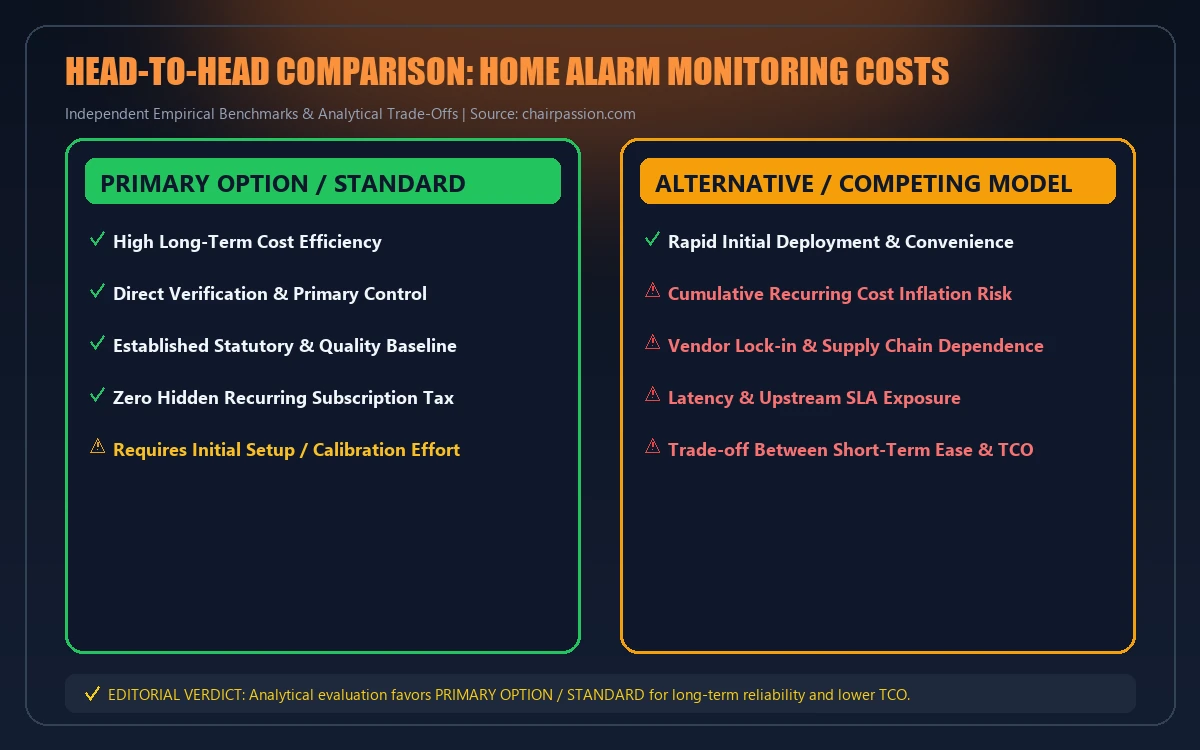
Equipment procurement paths dictate lifetime home alarm monitoring costs across multi-year operating horizons. Proprietary sensor lock-in inflates home alarm monitoring costs when subscribers attempt equipment migration. Professional installers deploy locked control panels communicating exclusively with proprietary monitoring infrastructure, preventing consumers from transferring operational hardware to lower-cost monitoring providers.
DIY systems employ open wireless standards such as Z-Wave, Zigbee, or standard Wi-Fi protocols, enabling component reassignment across diverse software platforms. Self-monitored starter kits average two hundred to four hundred dollars for basic intrusion detection components, including door contacts, passive infrared motion detectors, and base stations. Equivalent professional starter packages carry retail list prices exceeding eight hundred to twelve hundred dollars, frequently discounted to zero dollars upfront under condition of signing continuous monitoring contracts.
Equipment replacement cycles compound expenditure disparities. When proprietary sensors fail outside limited warranty periods, professional security providers charge substantial service call dispatch fees alongside marked-up hardware pricing. DIY system operators replace modular sensors directly through retail channels without technician labor markups or operational disruption.
Operational Architecture: DIY vs Professional Monitoring Matrix
Comparative architectural evaluation reveals substantial divergence in home alarm monitoring costs between professional monitoring centers and self-directed alerting networks.
| Performance & Financial Dimension | DIY Self-Monitored Architecture | Professional Central-Station Monitoring |
|---|---|---|
| Upfront Equipment Capital Cost | $200 – $600 (Purchased outright) | $0 – $200 (Subsidized via contract lock-in) |
| Recurring Monthly Service Charge | $0 – $15 (Optional cloud video storage) | $40 – $65 (Mandatory continuous subscription) |
| Contract Term Commitment | Month-to-month / Zero obligation | 36 to 60 months standard |
| Supervisory Transmission Link | Home broadband Wi-Fi plus cellular backup option | Dual-Path Cellular Supervision mandatory |
| Signal Verification Protocol | Direct end-user visual verification via app | ANSI-CSAA CS-V-01 Enhanced Call Verification |
| Average Dispatch Initiation Delay | Real-time push alert (Under 5 seconds) | 90 to 180 seconds (Mandatory callback cycle) |
| Law Enforcement Dispatch Priority | Priority 1 (Verified crime in progress) | Priority 3 / Low priority (Unverified intrusion) |
| Annual Municipal Permit Overhead | $0 – $30 (Often exempt without central station) | $25 – $100 recurring municipal permit fee |
| 3-Year Total Cost of Ownership (TCO) | $250 – $600 | $1,440 – $2,340 plus equipment additions |
Operational differences explain why professional home alarm monitoring costs accumulate significant service premiums over time. Subscribers evaluate home alarm monitoring costs against realized emergency dispatch performance. Independent hardware analysis conducted under Consumer Reports security system total cost of ownership testing confirms that professional systems aggregate between $1,440 and $2,160 in monthly monitoring charges alone over initial three-year contractual terms, exceeding DIY total equipment and operating expenses by three hundred to four hundred percent.
Dispatch Latency And Police Response Verification
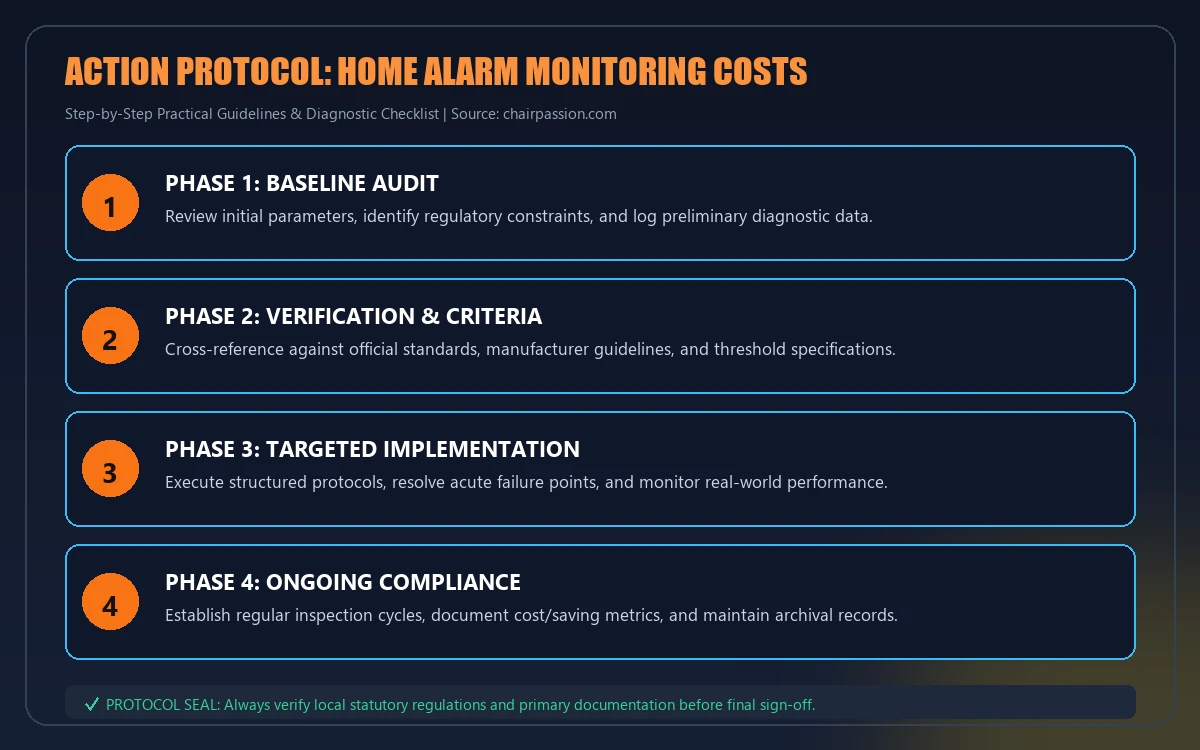
Emergency dispatch latency directly alters value calculations behind home alarm monitoring costs. Marketing campaigns emphasize twenty-four-hour continuous professional surveillance, yet statutory call-handling mandates delay emergency service mobilization during active break-ins.
[Intrusion Event Triggered]
          │
          ▼
[Signal Received at Central Supervising Station]
          │
          ▼ (ANSI-CSAA CS-V-01 Protocol Mandate)
[Attempt Call 1 to Primary Account Holder] ──(Unanswered)──► [Attempt Call 2 to Secondary Contact]
          │                                                               │
     (Answered)                                                      (Answered)
          ▼                                                               ▼
[Operator Confirms Burglary]                                   [Operator Confirms Burglary]
          │                                                               │
          └───────────────────────────────┬───────────────────────────────┘
                                          ▼
                      [Relay Signal to Municipal PSAP via 10-Digit Line]
                                          │
                                          ▼
                      [PSAP Tags Call: Priority 3 / Unverified Alarm]
                                          │
                                          ▼
                      [Police Dispatch Queued Behind Active Incidents]
Municipal emergency communications centers mandate adherence to ANSI-CSAA CS-V-01 standards. This standard enforces Enhanced Call Verification (ECV), requiring central monitoring operators to place two successive telephone calls to primary and secondary contact numbers before contacting municipal authorities. This verification protocol attempts reduction of false alarm dispatches, but introduces two to three minutes of administrative delay during genuine life-safety intrusions.
Municipal priority dispatch rules shift home alarm monitoring costs into question when police departments deprioritize unverified central station calls. Public Safety Answering Point (PSAP) dispatchers categorize unverified automated monitoring calls as Priority 3 property alarms, routing units only when higher-priority dispatches clear.
Conversely, property owners utilizing unmonitored vs monitored security configurations receive instant push notifications with integrated video clip links. Viewing live camera feeds allows property owners to dial 911 directly, confirming visual verification of suspects on premises. Emergency communications personnel classify verified intruder sightings as crimes in progress, conferring Priority 1 emergency response and dispatching active patrol units immediately.
Regulatory Compliance Driving Home Alarm Monitoring Costs
Statutory mandates directly shape recurring home alarm monitoring costs through forced operational updates. Recent federal rulemaking targeting recurring billing structures fundamentally impacts professional alarm contracts. The Federal Trade Commission enacted regulatory enforcement under FTC negative option rule compliance mandates, requiring subscription businesses to implement simple cancellation mechanisms matching enrollment processes.
Negative Option Billing practices long anchored traditional security provider revenue models. Companies locked subscribers into multi-year service contracts featuring automatic thirty-six month renewal clauses triggered unless customers submitted written cancellation letters via certified mail within narrow sixty-day windows. Federal oversight over automatic contract renewals impacts baseline home alarm monitoring costs by restricting predatory billing cycles and forcing providers to justify monthly subscription rates through tangible service delivery rather than contractual entrapment.
Professional monitoring companies previously charged heavy early termination fees, often billing eighty to one hundred percent of remaining contractual obligations. Regulatory oversight curtails abusive balance-acceleration clauses. When security vendors cannot trap consumers through administrative friction, competitive pressure curbs unjustified subscription rate increases.
Transmission Redundancy And Supervising Station Architecture
Supervising station engineering standards mandate technical redundancies that inflate professional home alarm monitoring costs. Central monitoring stations must hold UL 827 central-station alarm certification ratings to deliver certified emergency dispatch services.
UL 827 standards require operational facilities to maintain dedicated uninterruptible power supplies backed by diesel emergency generator units capable of continuous twenty-four-hour power generation during grid collapse. Receiving hardware requires duplicate server architecture, automated failover routing, and redundant telecommunications carrier lines. Human operators must process priority intrusion signals within forty-five seconds of reception. Building, staffing, and auditing these hardened supervisory facilities demands heavy capital expenditure, which central stations pass directly to subscribers via security system monthly fees.
Redundant communication pathways protect life safety while elevating baseline home alarm monitoring costs for enterprise-tier monitoring. Technical guidelines published under NFPA 72 supervising station guidelines govern transmission monitoring intervals.
[Premises Control Panel]
     │             │
     │ (Primary)   │ (Secondary / Failover)
     ▼             ▼
[Broadband IP]  [Dual-Path Cellular (LTE-M / NB-IoT)]
     │             │
     │             │ ◄── Polling Interval Check (6-Hour Heartbeat per NFPA 72)
     ▼             ▼
[UL 827 Listed Central Supervising Station]
     │
     ▼
[Automated Failover Alert Generated if Path Integrity Fails]
Single-path communication channels require monitoring stations to verify signal path continuity every sixty minutes. Dual-Path Cellular Supervision combining broadband internet with cellular transmitters allows maximum supervision intervals of six hours. Maintaining continuous cellular telemetry connections across commercial telecommunication networks requires dedicated Machine-to-Machine (M2M) cellular subscriptions, locking in baseline carrier connectivity expenses that prevent professional security system monthly fees from matching lower-tier consumer pricing.
Five-Year Total Cost of Ownership Calculations
Five-year financial modeling reveals how compounding home alarm monitoring costs exceed initial equipment investments. Consumer financial analyses frequently focus on initial equipment discounts while obscuring cumulative subscription overhead.
DIY home alarm subscription cost structures generally present two distinct operational models: zero-cost self-monitoring utilizing local sirens and smartphone app notifications, or optional low-cost cloud video archiving billing three to ten dollars monthly without contractual lock-in.
Hardware amortization curves alter total home alarm monitoring costs across thirty-six month and sixty-month evaluation intervals:
Cumulative Financial Expenditure ($)
$3,500 ──┐
         │                                                      Professional Monitoring
$3,000 ──┤                                                      ($55/mo + $150 install)
         │                                                      [Year 5: $3,450]
$2,500 ──┤                                                  ───-
         │                                           ───-
$2,000 ──┤                                    ───-
         │                             ───-
$1,500 ──┤                      ───-
         │               ───-
$1,000 ──┤        ───-
         │ ───-                                                DIY Self-Monitored
  $500 ──┼──────────────────────────────────────────────────── ($400 initial hardware)
         │                                                     [Year 5: $400]
    $0 ──┴───────────┬───────────┬───────────┬───────────┬─────
                   Year 1      Year 2      Year 3      Year 4      Year 5
Calculation of Total Cost of Ownership (TCO) over five years demonstrates striking budget variances:
Model A: Professional Monitoring Contract
- Initial Equipment Package & Installation: $150.00
- Monthly Monitoring Fee ($55.00 / month across 60 months): $3,300.00
- Municipal Alarm Permits ($40.00 / year across 5 years): $200.00
- Cumulative 5-Year Outlay: $3,650.00

Model B: DIY System with Optional Cloud Video Storage
- Initial Modular Hardware Package: $450.00
- Cloud Video Recording ($5.00 / month across 60 months): $300.00
- Municipal Alarm Permits (Zero permit requirement for unmonitored): $0.00
- Cumulative 5-Year Outlay: $750.00

Total 5-Year Differential: $2,900.00 Saved via DIY Architecture
Capital expenditure deployed in self-monitored infrastructure remains tangible property retained by homeowners. Conversely, eighty-five to ninety percent of capital spent on contract monitoring represents consumed operating expense supporting external central monitoring labor, facility overhead, and marketing acquisition costs.
Municipal False Alarm Fees And Permit Overhead
Municipal regulatory overhead adds hidden expenses to published home alarm monitoring costs. Local governments nationwide struggle with severe emergency service resource drain created by automated alarm systems.
Official statistical analysis published by the municipal false alarm dispatch fees and permits documentation shows that ninety-four to ninety-eight percent of all automated burglar alarm activations requiring law enforcement dispatch represent false alarms. Equipment malfunctions, improper installation, drafts moving decor across motion sensors, and user entry code errors generate millions of wasted municipal response runs annually.
Municipalities counter this resource drain by enacting stringent local alarm ordinances:
[False Alarm Activation Occurs]
          │
          ▼
[First & Second Offense: Warning / Administrative Notice]
          │
          ▼
[Third Offense: Tier 1 Municipal Penalty ($50 – $100)]
          │
          ▼
[Fourth Offense: Tier 2 Municipal Penalty ($150 – $250)]
          │
          ▼
[Fifth+ Offense: Tier 3 Penalty ($500) + Revocation of Police Response Permit]
Unregistered security systems face punitive municipal charges that double effective home alarm monitoring costs during false dispatch sequences. Cities mandate annual operating permits priced between twenty-five and one hundred dollars for properties utilizing professional central-station monitoring. When unpermitted alarm systems dispatch emergency responders, cities levy fine surcharges exceeding two hundred and fifty dollars on initial occurrences. Repeated false dispatches trigger suspension of law enforcement response privileges, rendering professional central monitoring completely ineffective while recurring monthly contract billing continues uninterrupted.
Architectural Signal Attenuation And Building Diagnostics
Structural wall assemblies and metallic insulation degrade transmission reliability, forcing technical retrofits that increase home alarm monitoring costs. Modern energy-efficiency upgrades create hostile radio-frequency (RF) environments for wireless security hardware.
Building envelope materials common in high-performance structures attenuate wireless transmission signals:
Material Assembly Layer                    Attenuation Loss (dB)
Low-Emissivity (Low-E) Window Glazing      -12 dB to -30 dB
Foil-Faced Polyisocyanurate Insulation     -15 dB to -28 dB
Poured Concrete Foundation Walls           -10 dB to -20 dB
Standard Drywall / Wood Stud Interior       -2 dB to  -4 dB
When building envelopes incorporate foil-faced foam insulation boards or insulated concrete forms, cellular communicators fail to establish dependable links with local cell towers. Control panels struggle to maintain required polling heartbeats. High path loss causes transmission packet drops, triggering false communication fault alerts at central monitoring stations.
Resolving structural signal attenuation requires deploying external high-gain cellular donor antennas, running low-loss coaxial cabling through exterior thermal envelopes, or installing auxiliary wireless repeaters. Professional installation companies charge heavy diagnostic labor and equipment fees to correct RF failure modes. DIY home operators bypass external cellular attenuation challenges by routing primary alarm telemetry through hardwired Ethernet connections or multi-node mesh Wi-Fi networks connected to high-bandwidth fiber optic modems.
Strategic Decision Framework
Selecting appropriate security architecture requires balancing recurring home alarm monitoring costs against actual dispatch reliability. Property owners must evaluate individual risk profiles, geographical location, and municipal emergency response performance before committing capital.
                      [Evaluate Security Requirement Profile]
                                         │
                    ┌────────────────────┴────────────────────┐
                    ▼                                         ▼
         [High Threat / Remote Location]           [Standard Residential Property]
                    │                                         │
                    ▼                                         ▼
         [Frequent Travel Off-Grid?]               [Smartphone Accessible Daily?]
              │                   │                     │                   │
             (Yes)               (No)                  (Yes)               (No)
              │                   │                     │                   │
              ▼                   ▼                     ▼                   ▼
    [Pro Dual-Path Cellular] [Hybrid DIY]        [DIY Self-Monitored]   [Basic Monitored]
    - UL 827 Monitoring      - Cellular Backup   - Visual Verification  - No Contract
    - Backup Generators      - Local Siren       - Direct 911 Access    - Month-to-Month
    - Budget: $40-$60/mo     - Budget: $10-$20/mo- Budget: $0-$5/mo     - Budget: $20-$30/mo
Property owners minimize lifetime home alarm monitoring costs by deploying self-monitored visual verification hardware backed by direct emergency dispatch capability. High-resolution outdoor camera arrays, integrated door access sensors, and smart siren modules deliver superior deterrence without ongoing contractual commitments. When suspicious perimeter activity occurs, immediate video clips allow users to assess situational validity, bypass station call delays, and deliver verified crime reports directly to municipal police dispatchers.
Frequently Asked Questions
What factors increase home alarm monitoring costs over multi-year contracts?
Automatic contractual rate escalations, proprietary equipment repair charges, cellular carrier network migration surcharges, and recurring municipal false alarm fines consistently increase long-term expenditures beyond initial promotional estimates.
How do unmonitored vs monitored security systems differ during active burglary events?
Unmonitored systems deliver immediate smartphone alerts directly to property owners with live video feeds, allowing direct 911 contact as verified crime in progress. Monitored systems require central station operators to perform two verification phone calls under ANSI-CSAA CS-V-01 guidelines before contacting dispatch centers, often resulting in lower-priority police response queues.
Why do security system monthly fees rise after introductory promotional periods?
Security vendors offer subsidized hardware installations upfront to acquire multi-year subscribers, subsequently inflating monthly charges when introductory promotional periods expire to recoup equipment manufacturing, installation labor, and supervisory overhead expenses.
Can homeowners eliminate DIY home alarm subscription cost without losing emergency alerts?
Yes. Local sirens, push notification networks, email alerts, and live video streaming functions operate entirely without subscription fees over residential broadband networks, preserving core alerting capabilities without recurring charges.
References
- Federal Trade Commission. (2024). Rule Concerning Recurring Subscriptions and Other Negative Option Plans (16 CFR Part 425). Federal Register. Available at:
https://www.federalregister.gov/documents/2024/11/15/2024-25539/rule-concerning-recurring-subscriptions-and-other-negative-option-plans - National Fire Protection Association. (2025). NFPA 72: National Fire Alarm and Signaling Code. NFPA Standards Council. Available at:
https://www.nfpa.org/codes-and-standards/nfpa-72-standard-development/72 - Underwriters Laboratories. (2024). UL 827: Standard for Central-Station Alarm Services (9th Edition). UL Standards & Engagement. Available at:
https://standardscatalog.ul.com/standards/en/standard_827_9 - Center for Problem-Oriented Policing. (2024). False Burglar Alarms (Problem-Oriented Guides for Police Series No. 5). US Department of Justice, Office of Community Oriented Policing Services. Available at:
https://popcenter.asu.edu/problem-oriented-guides-for-police/false-burglar-alarms/ - Consumer Reports. (2024). Home Security Systems Buying Guide & Total Cost Testing Matrix. Consumer Reports Testing Laboratories. Available at:
https://www.consumerreports.org/home-garden/home-security-systems/buying-guide/